Potato Worship, Wisdom, and...Mummies?
- Lily H
- 10 hours ago
- 8 min read
Experience this beautiful harvest through photos linked here!
We inch away through the soil, breaking apart clumps with our sturdy picotas (hammer-like tools with sharp, flat heads) to uncover dense bunches of potatoes beneath us. With our hands deep in the soil, we sift around to feel for every little potato nugget, ranging from grape- to fist-sized. Each short row yields hundreds, and we toss handful after handful into massive piles sorted by variety. We sometimes take dance breaks, pulling out traditional Aymara instruments (check them out here!) and spinning each other around in circles, landing our dancing partners atop the piles.
(Tossing the Potatoes into their Piles - 05/13/26)

(Tossing a Person into a Potato Pile while Dancing - 05/13/26)
Today, the International Potato Center joined the World Monuments Fund, Mater, and Waru Waru communities of Acora to celebrate the potato harvest and learn from community experts (Los Sabios), whose wisdom and expertise sustain potato biodiversity and conservation, and learn about their traditions and ceremony. Filled with dancing, harvesting, and feasting on potatoes of all shapes, sizes, textures, and preparation methods (from mummified potatoes to potatoes smoked underground), today was a day spent learning about local traditions, ceremonies, values, and deep cultural connections surrounding the potatoes of the Andean plains. More than anything, it was a day that filled me up with soil under my nails, starch in my tum, and gratitude and connection in my heart.
I scooped up a spare picota and began cutting into a row, doing my best to imitate the people around me and hoping I was using it correctly. Thankfully, the sabia (the name for a knowledgeable farmer and community expert) next to me came over to show me how it was done, smiling as she gently flipped my picota to the other side. I later learned that this particular bed belonged to her family, and I feel honored that she trusted me to harvest the products of her family’s hard work, the food that would sustain them.

(Harvesting Las Papas - 05/13/26)
While each family held ownership of one or two individual beds, the collection of raised beds making up the Waru Waru system belonged to the entire community. This shared network supported collective benefits, as it gave the community a space to come together to work, support each other, and celebrate together. It also promoted shared resilience, as the circular raised beds (terraplanos) of this Waru Waru system were not just visually striking and beautiful, but highly functional, with its design protecting crops in unstable and fluctuating climate conditions.

(A Family Harvesting their Terraplanos/Raised Beds - 05/13/26)
Here in the high-altitude Altiplano region of Peru, temperatures may rise to 50-60 degrees Fahrenheit during the day, but drop drastically during the night, regularly dipping below freezing temperatures in the months of June and July. At an elevation of around 3,800+ meters, low air pressure (thin air), the lack of cloud cover, and intense solar radiation create weather conditions with drastic deviations.1,2 During the day, the intense solar radiation rapidly hits and heats the ground without obstruction, but the atmosphere is too thin and with air lacking in water vapor to trap and hold heat, which instead dissipates into space at night.1
My friend Helen, a student and member of the Aymara Waru Waru community of Acora (next to the city of Puno), explained to me that traditionally, a single night of frost could wipe out an entire harvest, shriveling potato plants’ leaves and turning the tubers (the potato portion) to mush as the moisture inside froze, expanded, and erupted the cell walls and tissues within the potatoes. Tubers buried at shallower depths were especially vulnerable.3
To address this vulnerability, pre-Incan Andean civilizations in this region developed the Waru Waru system, dating back to approximately 1000 BCE, to protect crops from sudden climatic shocks and improve overall resource efficiency.4 These systems feature raised agricultural beds bordered by water channels that fill naturally with rainwater during the wet season (from around December through March) without artificial irrigation.5 The raised beds improve soil aeration and drainage, preventing water logging and thus reducing the risk of root rot during the wet season.6 At the same time, the surrounding water channels were concentrated together to reduce evaporation, conserving water during the dry season.6 Importantly, the water in these channels also played a thermal role, trapping heat during the day and releasing it during the night to buffer and protect crops from extreme cold and frost damage.6
(Waru Waru raised beds near Acora - 05/13/26)
Without the Waru Waru design, farmers often rely on more labor-intensive practices, like covering potatoes with extra soil, burying them deeper to insulate them from the cold, as our team helped do during a visit to another field site where conventional cropland lacked this system. An additional benefit of the water canals is their ability to capture and recycle nutrients. Organic matter like plant residues, animal feces, and other material accumulate in the bottom of these channels, breaking down into a nutrient-rich sludge that farmers can harvest and apply to the beds as fertilizer.6
This design also increases crop resilience to increasingly variable weather patterns from climate change. In particular, shifts in wind systems are expected to decrease moisture availability in the Altiplano region. Summertime easterly winds, bringing moisture from the Amazon side of South America toward the mountains (from east to west), are expected to weaken while westerly winds bringing drier air from the Pacific (from west to east) may become more prevalent, leading to fewer rain events, drier soils, and greater drought stress.7,8,9 In this context, the water retention benefits of the Waru Waru system become increasingly important.
While Waru Waru systems protect crops, allowing for more stable and reliable growth, Andean communities also developed different potato preservation methods to ensure a year-round supply of this staple food source, safeguarding against seasonal shortages. One highly important practice involves something of a potato mummification process to create a shelf-stable product called chuño. With origins in pre-Columbian times, this process uses extreme daily temperature variations during the dry season (ranging from 65 - 14 degrees Fahrenheit in day/night fluctuations between the months of June and July) to freeze dry specific types of small, bitter potatoes.10,11
To create chuño negro, farmers lay these potatoes out exposed to the elements for about a week to freeze during the night and thaw during the daytime, scorching under strong solar radiation. After this first week of drying, sometimes families wash their feet and stop on the potatoes to squish out the moisture and expedite the drying process, inviting neighbors to join in, while other times, they peel the potatoes to achieve the same goal. After this, the potatoes are laid out for a couple more weeks to truly shrink down to about a fifth of their initial size. With the help of solar heating and freezing and thawing cycles, this chuno is given its characteristic black color, and with a good bit of scorching and stomping, the toxic glycoalkaloids are removed, helping to rid the potato of its bitter taste.11

(Tasty Chuño Negro - 05/16/26)
In an extra classy and high-quality version of chuno, chuño blanco, known as 'moraya' in Quechua-speaking areas and 'tunta' in Aymara-speaking areas, the process is modified to create a lighter color and milder flavor. The potatoes are covered during the initial freezing and thawing process to prevent scorching, and then potatoes are placed in permeable plastic bags and left in fresh water for 20-30 days, sheltered from the sun, to leach the toxins and bitterness out of the porous potato body.12 With both techniques, chuño is so stable that it can last for decades, providing a reliable food reserve during times of food scarcity and a staple in daily meals, added to soup or paired with cheese, clay salsa, avocado, or meat for a yummy, filling meal.
While potato harvest and preparation is no small feat, requiring deep knowledge of weather patterns and seasonal cycles, hard labor, and long hours, the work is fun and rewarding. On this day of harvest, the community gathered together not just to work, but to celebrate; give thanks to and repay the earth; and to dance, joke and laugh, toast, and feast together.
We began the day with traditional music played on beautiful Aymara instruments (check out a few here!), dancing around the Waru Waru beds and waving vibrant, woven textiles to the rhythm of the music to call spirits of different potato varieties, each with its own unique identity. All of the sounds and colors were meant to attract them, and we drew them in with our textiles.
(Music, Dancing, and an Invitation to the Potato Spirits - 05/13/26)
We then formed a circle, where each person took turns scooping sacred coca leaves from a shared bag, dipping them in wine, putting them to our mouths in prayer to Pachamama (the Earth goddess) for fertility and abundance, and then burning them in a sacred, colorful fire (although they are sometimes buried) as an offering of reciprocity to the earth, carrying our gratitude and prayers.13 We then chewed on some coca leaves ourselves, unifying and connecting with Pachamama.14

(Coca Offering to Pachamama - 05/13/26)

(Colorful Fire - 05/13/26)
Following this ritual, we sprinkled colorful streamers, confetti, and flowers into the fire and our hair, and all charged up, we energetically danced around the Waru Waru beds, laughing and smiling, on our way to our own beds to harvest. As we worked, we sniffed wafts of a feast being prepared nearby. In shallow pits dug in the soil nearby, stones and composted material (including hay, soil, and some sterilized manure) were mixed together and heated to create the iconic huatia, a traditional Andean earth oven, which we used to roast potatoes, giving them an earthy, smoky, and crisp flavor.15 Yum.
When the scent became too irresistible, we gathered together in a big circle around the piles of huatia potatoes and grabbed handfuls, pairing them with sauces of cheese, avocado, and even clay in a celebratory feast to celebrate our day of connection and fruitful work with full hearts and bellies. And bladders – it was a bit tricky finding a good bathroom spot with flat plains stretching as far as the eye could see.

(A Huatia Feast - 05/13/26)

(Gorgeous Paisaje/Landscape - but no good bathroom spot - 05/13/26)
Joining the Aymara community of Acora for this harvest was a beautiful experience and a powerful example of how practices of appreciation and reciprocity can build connection among people and the earth. These Aymara Waru Waru cultivators are stewards of the earth, preserving and sustaining millennia of knowledge, potato biodiversity, and tradition.
Each potato variety and its name has value and tells its own story. A mini-interview with my mentor and potato expert Dr. De Haan, the Senior Scientist on Andean Food Systems at CIP, revealed some fun potato names and stories. Dr. De Haan considers one of the funniest potato names to be “Payapa Ankun,” which translates to “an old woman's calf” because of its resemblance.16 To him, some of the most beautiful names include “Paqocha Senqa,” meaning “Alpaca nose;” “Ancapa Sillun,” “Hawk’s Nail,” and “Kaywa.”

(Paypa Ankun/Old Woman’s Calf - Image from https://cipotato.org/wp-content/uploads/PDF/003524.pdf, August 2006)
I quite like the potato called “Huevo de Pato,”which translates to “Duck’s egg;”17 the stripped “Zorrilla,” which captures the pattern of the “Skunk”17 well; and “Gallinaza,” which with its shape and bumpy texture, quite resembles its translation “Chicken manure.”18
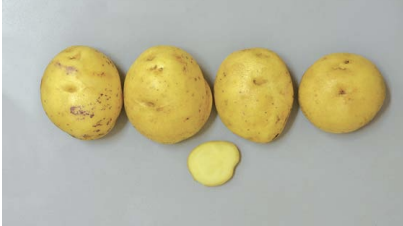

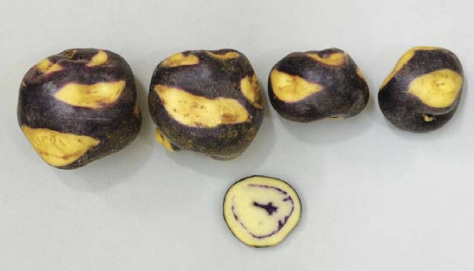
(Huevo de Pato/Duck’s Egg & Zorrilla/Skunk - Images from https://www.poderosa.com.pe/Content/descargas/libros/catalogo-de-variedades-de-papa-nativa.pdf, October 2015)

(Gallinaza/Chicken Manure - Image from https://repositorio.inia.gob.pe/items/7613ef47-9da6-4521-b4b5-6fe450a14d96, May 2023)
Members of these Waru Waru communities are conservationists of biodiversity, culture, and heritage, with these thousands of varieties coming from their experience and expertise. And these varieties aren’t just contained within their individual communities but shared across Peru, incorporated into widespread dishes of national pride and supporting the food security of big cities. These potatoes serve as a symbol of cultural pride, social and climate resilience, and continuity.
Thank you so much for reading! This coming week, I'll be visiting research facilities at the International Potato Center, based in Lima, and reporting on research promoting sustainable, inclusive food systems and food security. Stay tuned!
Peace out,
Lily :)
References
https://www.terrasigna.com/life-in-el-altiplano-snow-cover-extent-service.html
https://www.wmf.org/monuments/waru-waru-agricultural-fields-peru
https://rmets.onlinelibrary.wiley.com/doi/full/10.1002/joc.8013
https://journals.ametsoc.org/view/journals/clim/24/17/jcli-d-11-00051.1.xml
https://agupubs.onlinelibrary.wiley.com/doi/10.1029/2008JD011021
https://www-sciencedirect-com.ezproxy.rice.edu/science/article/pii/S2352409X2200267X
https://www.kantuperutours.com/blog/es/huatia-peruana-el-horno-de-tierra
https://www.poderosa.com.pe/Content/descargas/libros/catalogo-de-variedades-de-papa-nativa.pdf
https://repositorio.inia.gob.pe/items/7613ef47-9da6-4521-b4b5-6fe450a14d96